USCIS processing times, and how they have changed.
USCIS shows only the current estimate. FillingTide keeps every dated publication for 7 forms across 92 field offices, so you can see whether the office handling your case is getting faster or slower.
Free and public. No account required.
Largest change since Jan 2026
USCIS published Aug 17, 2026
I-485 Family-based adjustment
San Jose CA field office
80% of cases completed within
31.5 months
since Jan 2026
- January 14, 2026: 10 mo
- February 18, 2026: 10.5 mo
- March 16, 2026: 11.5 mo
- April 21, 2026: 12 mo
- May 22, 2026: 15 mo
- June 23, 2026: 17 mo
- July 15, 2026: 23.5 mo
- August 17, 2026: 31.5 mo
8 dated USCIS publications. No interpolation, no forecast.
See the full historyFree tools for a specific question
Get the answer, then check the rule behind it. Both calculators work without an account.
What the latest publication changed
Every tracked series compared with its first publication in Jan 2026. USCIS published the latest figures on August 17, 2026.
- slower
- 168
- faster
- 14
- unchanged
- 4
Counts describe the published 80th-percentile processing time for 186 tracked series. They describe past publications, not future case outcomes.
Compare 60-day trendsLargest changes since Jan 2026
- I-485 Family-based adjustment31.5 months+21.5 monthsSan Jose CA
- I-130 Immediate relative80 months+19.5 monthsAll Field Offices
- I-485 Family-based adjustment23 months+13.5 monthsSanta Ana CA
- I-485 Family-based adjustment22.5 months+12.5 monthsRaleigh NC
- I-485 Family-based adjustment21 months+11.0 monthsSan Francisco CA
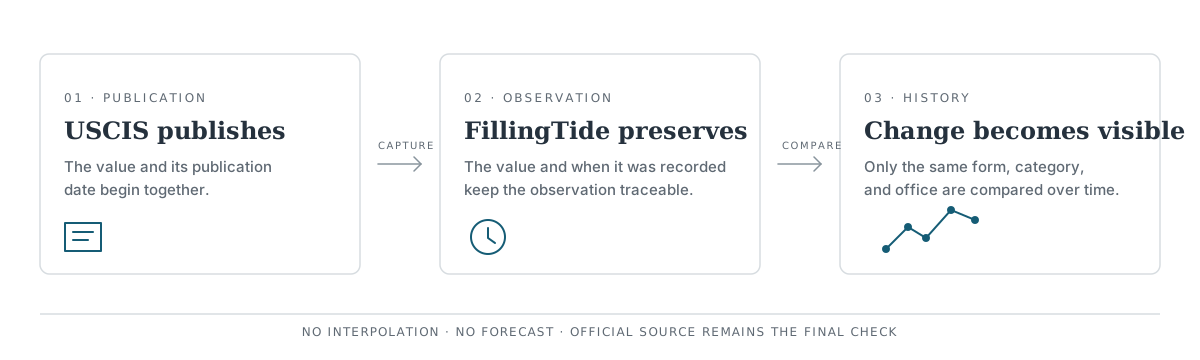
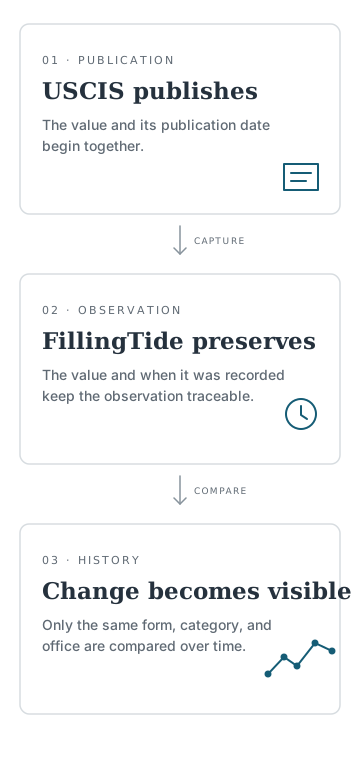
How a single USCIS number becomes a history you can check
USCIS overwrites its estimate with each publication. FillingTide records each one with its date, then compares only the same form, category, and office over time.
Find your form
Each form page compares its tracked categories and offices and links every value to its dated history.
- I-130Petition for Alien Relative3 tracked
- I-131Application for Travel Documents, Parole Documents, and Arrival/Departure Records2 tracked
- I-485Application to Register Permanent Residence or Adjust Status90 tracked
- I-751Petition to Remove Conditions on Residence2 tracked
- I-765Application for Employment Authorization3 tracked
- I-90Application to Replace Permanent Resident Card2 tracked
- N-400Application for Naturalization90 tracked
Or start with your field office
Every office page compares its current N-400 naturalization and I-485 family-based adjustment times. These 18 are the most searched of the 92 covered.
- Houston TX2 tracked
- Seattle WA2 tracked
- Boston MA2 tracked
- Chicago IL2 tracked
- New York City NY2 tracked
- Los Angeles CA2 tracked
- San Francisco CA2 tracked
- Dallas TX2 tracked
- Atlanta GA2 tracked
- San Antonio TX2 tracked
- San Diego CA2 tracked
- San Jose CA2 tracked
- Miami FL2 tracked
- Detroit MI2 tracked
- Tampa FL2 tracked
- Newark NJ2 tracked
- Phoenix AZ2 tracked
- Philadelphia PA2 tracked
Two USCIS numbers, two different questions
The processing time tells you how long 80% of recently completed cases took. The case inquiry threshold is a separate, later cutoff that decides when you may ask USCIS about a case. FillingTide never merges them into one range.
Check your receipt date against the current cutoff- Processing time
- How long 80% of completed cases took. A historical aggregate, not a prediction for your case.
- Case inquiry threshold
- The 93rd-percentile boundary. Cases filed before this date may ask USCIS a question.
- Your receipt date
- When USCIS received your filing. Compare it with the threshold, not the processing time.
How FillingTide handles the data
Source-linked
Every page names the USCIS publication date, the observation date, and the official source.
Historical by design
7 or more dated USCIS publications per series make changes visible without inventing a forecast.
Built for careful use
Clear limits, no case-level promises, and no fabricated expert review.
Source and provenance
USCIS publishes the underlying processing-time figures. FillingTide records the publication and observation dates so changes can be compared over time. Verify time-sensitive information on the official USCIS page . Read our data-source notes.